Introduction
You scroll. You watch. You know exactly what your coworker had for dinner last Saturday, which of your friends just got engaged, and which influencer is currently being cancelled, but you have not posted a single thing in months. Maybe years.
A large portion of social media users never post, comment, or interact publicly at all. They simply watch. These are the social media silent scrollers and despite being nearly invisible on your feed, they make up a significant chunk of every platform’s user base. Studies show 85% of users consume content while only 15% actively create it.
In this article, we break down the most common social media silent scroller traits, explore the psychology behind why, and look at what this consumption pattern actually says about a person.
Who Is a Social Media Silent Scroller?
A social media silent scroller is someone who regularly uses social media platforms, checking feeds, watching stories, reading comment sections, keeping up with trends, but rarely or never participates publicly. No posts. No comments. No likes. They are present everywhere and visible nowhere.
A silent scroller is the modern, mobile-first version, someone who opens Instagram fifteen times a day, knows every TikTok trend before it peaks, and still has zero posts on their profile.
It is important to draw a clear line between three types of social media users:
- Active users: Post regularly, engage with comments, build an audience.
- Occasional posters: Share content sometimes, engage selectively, maintain some presence.
- Silent scroller: Consume consistently, engage almost never, maintain little to no public footprint
Silent scrollers are firmly in that third category. They are passive social media users by choice.
What makes this behavior worth understanding is how common it actually is. Silent users on social media are not the minority, in most spaces, they are the majority.
7 Social Media Silent Scroller Traits
1. They Observe Without Engaging
The most defining trait of a silent scroller is the complete disconnect between how much they consume and how little they interact. They will watch your entire story and read every comment under a viral post, then close the app without leaving a single trace.
2. They Are Highly Aware of Other People’s Lives
Do not let the silence fool you. Silent scrollers are arguably the most informed people in any social circle. They know about the breakup, the promotion, the vacation, and the subtle drama in the comment section, all without asking a single question.
This deep social media observer personality means they often know things about people that those people have half-forgotten they posted. It is not stalking. It is simply paying attention while everyone else is busy performing.
3. They Rarely Post
Their profile has few posts, but their following list tells a completely different story. They follow carefully and intentionally. Non-posting social media users are not disengaged from the platform.
4. They Have Strong Opinions They Keep to Themselves
Silent scrollers are not indifferent. They have opinions, sometimes very strong ones. They read the debate, pick a side internally, and then close the app. The comment section never gets to hear it.
5. They Are Selective About Who They Follow
There are no random follow-backs. No following someone just because they followed first. A silent scroller’s feed is curated and intentional, built over time to reflect exactly what they want to see and nothing else.
6. They Prefer Consuming Over Creating
Content creation requires energy, vulnerability, and a willingness to be seen. Silent scrollers prefer none of that. Their social media consumption habits are high volume but entirely one-directional. The idea of posting is just unappealing. Why produce content when consuming it is already satisfying?
7. They Feel Uncomfortable With Public Validation
For most users, likes and comments are motivating. For silent scrollers, they are uncomfortable.
Posting something and then waiting to see how people respond feels performative and anxiety-inducing.
Are Silent Scrollers More Mentally Healthy?
If silent scrollers avoid the comment section drama, and the followers count anxiety, does that make them better off mentally than their active counterparts?
The case for silent scrolling being healthier:
Research into social media and mental health consistently points to active, performance-driven use as a key stressor. The cycle of posting, waiting for validation, comparing engagement metrics, and managing public perception is genuinely taxing. Silent scrollers are out of that entire loop.
They do not lose sleep over a post that underperformed. They do not feel the pressure to respond to comments within a certain window.
Studies examining passive social media users have found that people who primarily consume rather than post report lower levels of social anxiety related to their online presence specifically. They feel less exposed and less dependent on external validation.
The case against assuming silent scrolling is always healthy:
While silent scrollers avoid the pressures of performing online, they are still fully exposed to the content itself and that content does not stop affecting them just because they are not engaging with it publicly.
Social comparison is the clearest risk. A silent scroller who spends an hour moving through highlight reels of other people’s relationships, bodies, careers, and lifestyles is absorbing all of that without any of the offsetting experience of sharing their own life positively.
The quietness of the habit is both its strength and its blind spot. Because there are no public metrics to reflect the behavior back at them, no post history, no engagement data, quiet social media users can overconsume for a long time without any external signal that something is off.
Silent Scroller vs. Lurker Is There a Difference?
The two terms are often used interchangeably, and for good reason, the behavior overlaps significantly. But they are not quite the same thing, and the distinction is worth making clearly.
Both silent scrollers and lurkers consume without contributing. Neither posts regularly. Both maintain a low or invisible public profile while staying highly informed about what is happening in their online spaces.
The word “lurker” originates from early ages of internet culture. In that context, a lurker was someone who joined a community space and read the discussions without ever posting. The term carried a slightly negative meaning, implying someone hovering on the conversation they were too cautious or too passive to join.
Silent scroller is a newer, more neutral framing built around the mobile-first, algorithmically-driven social media era. It is less about community spaces and more about content consumption at scale.
What Platforms Do Silent Scrollers Prefer?
Some actively rewarded lurking makes it easy to consume endlessly without ever being prompted to contribute.
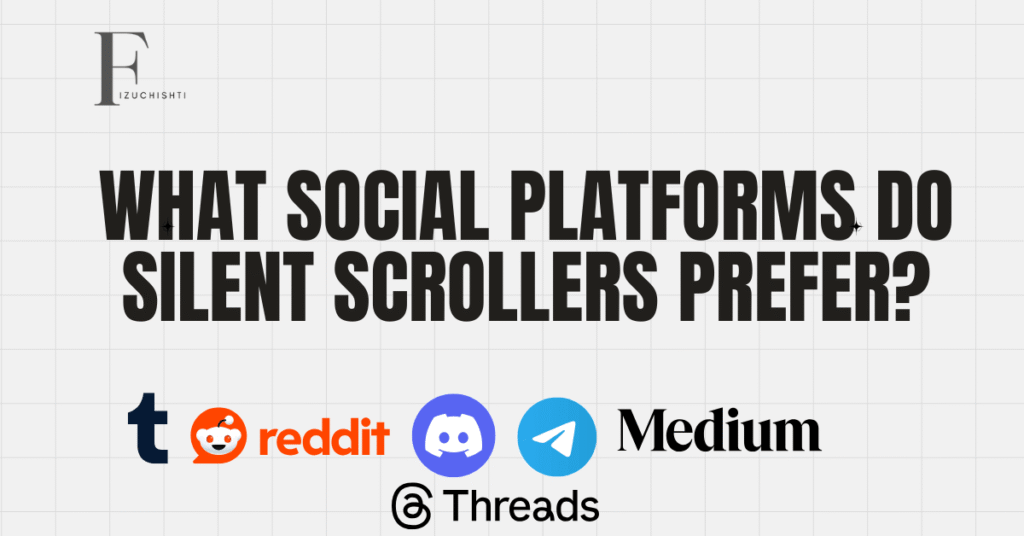
1. Reddit (The Silent Scroller’s Natural Habitat)
Reddit is structurally the most lurker-friendly platform on the internet. You do not need an account to read threads, browse communities, or follow entire conversations from start to finish. Even registered users frequently never post, they join subreddits aligned with their interests and consume.
There are no follower counts on personal profiles that make inactivity visible. No algorithm pushing you to post more.
2. Twitter / X
Silent scrollers use it primarily as a news and opinion feed, tracking trending topics, following breaking stories, reading hot takes from accounts they would never interact with publicly.
Many silent scrollers maintain accounts purely to access lists and follows, with no intention of contributing to the conversation themselves.
3. Instagram Stories
Instagram Stories were, perhaps unintentionally, one of the greatest features ever built for passive social media users. Silent scrollers can move through dozens of updates from friends and strangers in minutes, seeing exactly what people are doing, thinking, and promoting, all anonymously from the perspective of the poster.
4. TikTok ( Pure Consumption by Design)
TikTok is the platform most architecturally aligned with silent scroller behavior. Its entire model is built around the For You Page, an algorithmically generated feed that requires no social graph, no follows, and no personal history to function. You do not need to follow anyone. You do not need to post.
The social media consumption habits TikTok encourages are almost entirely passive by design. Watch, move on, watch again. The platform does everything possible to keep users consuming and very little to push them toward creation.
5. LinkedIn
LinkedIn is interesting because it is the platform silent scrollers most often feel obligated to be on but least enjoy using. The professional context makes passive consumption feel more acceptable reading industry news, tracking career moves, following thought leaders.
Silent scrollers use LinkedIn the way they use most platforms, observing, tracking, staying informed, but they tend to feel the social pressure to engage more acutely here than anywhere else, precisely because professional visibility feels like it carries real-world consequences.
Can a Silent Scroller Ever Become an Active User?
Yes, but it rarely happens overnight, and for most silent scrollers, it does not happen at all unless something fundamentally shifts.
The transition, when it does occur, tends to be community-driven. Silent scrollers are far more likely to start engaging when they find a niche space that is genuinely aligned with their interests, a small subreddit, a private group, a comment section where the tone is consistently respectful.
The honest answer is that they do not become active users. Silent scrolling is a legitimate and sustainable way to use social media. The platforms would prefer you post, engage, and feed the algorithm. But there is no rule that says you have to.
Conclusion
Social media was built on the assumption that people want to share. But a significant portion of its users have always preferred to simply watch, and that preference is not a flaw, a phase, or a problem to be fixed.
Social media silent scroller traits paint a picture of someone who is observant, private, selective, and intentional. They know more than they let on, consume more than they produce, and engage with the online world entirely on their own terms.
Whether the motivation is privacy, fear of judgment, or simply a preference, silent scrollers represent a large invisible segment of every platform’s user base. They are present in your follower list, your story views, and your post analytics, they just never announce themselves.
Frequently Asked Questions
What is a social media silent scroller?
A social media silent scroller is someone who regularly uses social media to consume content, and watch stories but rarely or never posts. They maintain an active presence as a viewer.
Is silent scrolling the same as lurking?
They are closely related but not identical. Lurking is an older internet term tied to forum and community-based spaces.
Silent scrolling is the modern equivalent, specific to algorithmic, mobile-first social media platforms like Instagram, TikTok, and Twitter. All silent scrollers exhibit lurking behavior, but the context and identity around the habit have evolved.
Are silent scrollers introverts?
Many silent scrollers lean introverted. Extroverts can be silent scrollers too. The stronger common thread is a preference for private observation over public performance, which is a personality trait distinct from introversion specifically.
Is silent scrolling bad for mental health?
Silent scrolling can reduce the stress of online performance. However, only watching can increase social comparison and loneliness over time. Mindful use can make a difference between a healthy and a harmful.
How common are silent scrollers on social media?
Extremely common. Most platforms operate on what researchers call the 90-9-1 rule, roughly 90% of users consume without contributing, 9% engage occasionally, and only 1% create the majority of content. Silent scrollers are not the minority.
They are, by a wide margin, the majority of most platforms’ active user base.